
The Ultimate Guide to Visiting the Falkland Islands
Wildlife, weather, penguins, photography and how to experience one of the South
Atlantic’s most remarkable archipelagos
There is a moment many first-time visitors to the Falkland Islands experience when they realise the place they imagined is not quite the place they have arrived in.
First, there is the scale.
On a world map, the Falklands can look like little more than a speck in the South Atlantic. On the ground, they feel enormous. The archipelago consists of more than 700 islands, with a coastline of cliffs, sheltered coves, long beaches and remote headlands. There are places that can be reached by road, others by small aircraft, and still others where travelling by sea opens possibilities that simply don’t exist overland.
Then there is the weather.
People sometimes arrive expecting something approaching Antarctica — snow, ice and relentless cold. The Falklands are far more temperate. Summer days can be surprisingly pleasant, although the wind and rapidly changing weather should never be underestimated.
And then there is the wildlife.
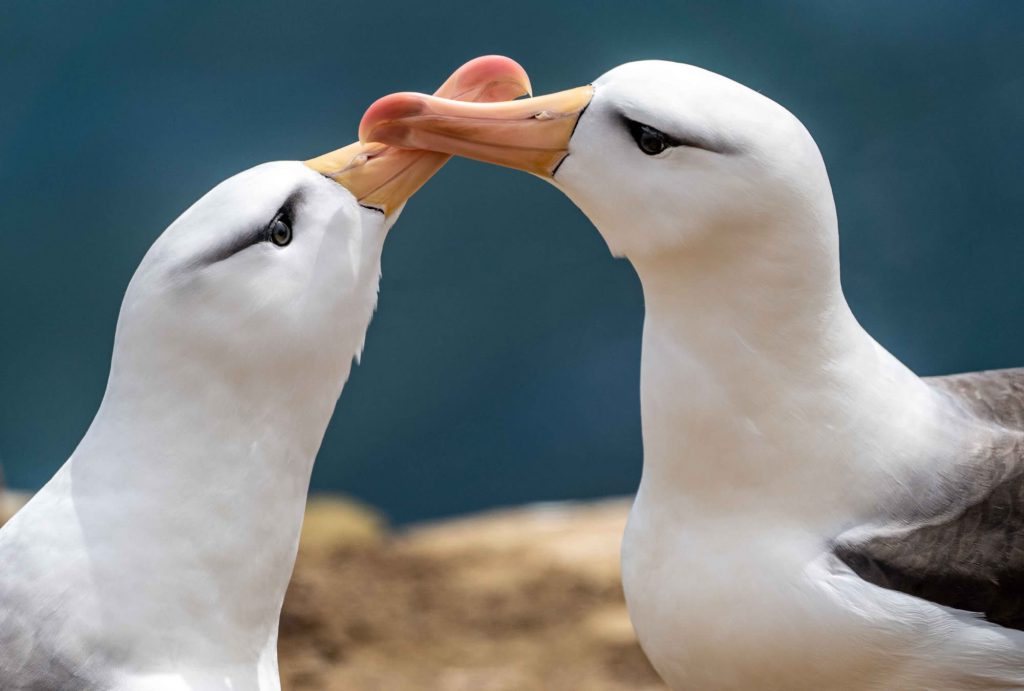
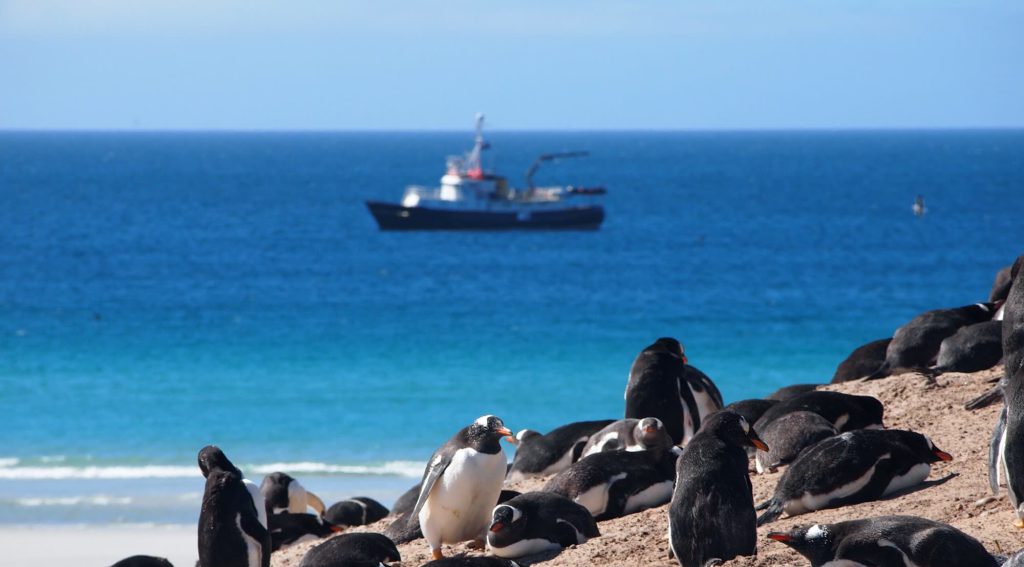
Penguins cross beaches in front of you. Black-browed albatrosses sweep past cliffs on enormous wings. Dolphins may appear alongside a boat simply because something has caught their curiosity.
But perhaps what surprises people most is the space.
The Falklands remain somewhere you can sit quietly and watch wildlife behaving naturally, walk along an empty beach, visit a working island farm, or stand on a headland with very little between you and the South Atlantic.
For us at LatitudeX, the Falklands aren’t simply another destination on our map. They are at the heart of our story.
This guide is our introduction to experiencing them properly.
Where are the Falkland Islands?
The Falkland Islands lie in the South Atlantic, east of southern Patagonia.
The archipelago is centred around the two largest islands — East Falkland and West Falkland — but extends across hundreds of smaller islands and islets.
Stanley, on East Falkland, is the capital and the starting point for many visitors. But Stanley is only one small part of the Falklands.
Getting beyond it changes the experience considerably.
The islands can be explored by road and 4×4, by the Falkland Islands’ small inter-island aircraft, by sea, and by combining several forms of transport.
This is one of the first things to understand when planning a trip: the way you travel determines the Falklands you get to see.
Why visit the Falkland Islands?
For many people, wildlife is the initial reason.
And that’s understandable.
The Falklands support extraordinary concentrations of seabirds and marine wildlife, including five breeding species of penguin, black-browed albatrosses, elephant seals, sea lions and numerous species of dolphins and whales.
But wildlife is only part of the story.
There are huge open landscapes, remarkable walking, white-sand beaches, cliffs, sheltered bays, isolated settlements and working farms.
There is history here too, both distant and recent.
And there is a way of life shaped by distance, weather, sea and the practical realities of living on remote islands.
The Falklands particularly suit travellers who enjoy wildlife, photography, walking, birding and history, and people who are prepared to step away from the conventional tourist trail.
They also reward travellers willing to slow down.
This isn’t a destination we believe should be rushed.
When is the best time to visit the Falkland Islands?
For most wildlife-focused visitors, the austral spring and summer are the key seasons.
We particularly like the period around midsummer.
The days are long, conditions tend to become more settled, and the extended daylight gives you much more time outdoors — particularly valuable for walkers, wildlife watchers and photographers.
Late spring, however, has an energy of its own.
This is when the breeding season is gathering momentum. Birds are returning, nesting and raising young, and colonies become intensely active.
The right month therefore depends partly on what you want to see.
A photographer interested in breeding behaviour may make a different choice from somebody prioritising long summer days and walking.
It’s also important not to think about Falklands weather purely in terms of temperature.
The wind matters.
Conditions can change quickly, and even during summer it is worth being prepared for several different versions of the day.
Coming soon: Best Time to Visit the Falkland Islands — A Month-by-Month Wildlife & Weather Guide
Wildlife in the Falkland Islands
Wildlife in the Falklands is not something you simply tick off a list.
The privilege is having time to watch it.
One of our favourite experiences is simply sitting near a colony and observing what unfolds — penguins moving between the sea and their nests, birds interacting with one another, or albatrosses using the wind along a cliff.
Sometimes the encounter comes to you.
On one memorable occasion, hundreds of Commerson’s dolphins appeared after noticing our presence. They played around us, surfing through the waves near the beach and approaching our Zodiacs.
There was no performance and no guarantee.
They simply chose to be there.
Those unscripted encounters are part of what makes travelling in the Falklands so special.
Penguins of the Falkland Islands
Five penguin species breed in the Falklands:
- King penguin
- Gentoo penguin
- Southern rockhopper penguin
- Magellanic penguin
- Macaroni penguin
Macaronis are considerably more unusual, with only a small breeding population in the islands, making an encounter with one a bonus rather than something that should ever be promised.
The other four species can be encountered at a variety of locations around the archipelago.
Volunteer Point
For king penguins, Volunteer Point is one of the iconic Falklands locations.
Its large king penguin colony is accompanied by gentoo and Magellanic penguins, making it an extraordinary place to spend time observing several species.
Getting there is part of the experience: Volunteer Point is reached overland from Stanley, with the final part of the journey requiring travel across rough terrain.
Saunders Island
Saunders is particularly rewarding for its wildlife diversity and walking.
For us, that’s an important combination.
It isn’t simply about arriving, photographing an animal and leaving. Being able to walk through the landscape and experience wildlife in its wider environment gives you a much stronger sense of the Falklands.
Steeple Jason
Then there is Steeple Jason.
Remote, exposed and spectacular, it is renowned for its immense colony of black-browed albatrosses.
Watching these birds from the cliffs is one of those experiences that is difficult to communicate through statistics.
Albatrosses are built for the wind. Watching them use it — seemingly effortlessly — while you sit quietly on the edge of their world is one of our favourite Falklands experiences.
Given a completely free day, with no itinerary and nowhere we had to be?
We’d happily spend it walking on a beach and sitting on the cliffs watching the albatrosses.
Sometimes the simplest days are the best ones.

How close can you get to wildlife in the Falklands?
The quality of a wildlife encounter isn’t measured by how close you can get.
It’s measured by how little your presence changes what the animal was already doing.
As a general principle, Falklands conservation guidance recommends remaining at least 6 metres / 20 feet from wildlife.
But distance alone isn’t enough.
Watch the animal.
If your presence is changing its behaviour, creating agitation or interfering with its route between a colony and the sea, give it more space.
Sometimes wildlife will choose to approach you.
When that happens, remain quiet and let the animal control the encounter.
For us, the principle is straightforward:
Observe. Don’t interfere. Let the wildlife decide.
The Falklands for photographers
There are destinations with spectacular wildlife.
There are destinations with spectacular landscapes.
The Falklands offer both — and often without the crowds that photographers encounter elsewhere.
That combination makes the islands exceptional for photography.
There is the sheer abundance of wildlife, but also proximity, dramatic backgrounds and the opportunity to spend meaningful time observing behaviour rather than rushing from one sighting to another.
During summer, long daylight hours create even more possibilities.
And photographers shouldn’t assume that everything requires the longest lens in the bag.
The wider environment is part of the story here.
A penguin against an empty beach, an albatross above a cliff, wildlife moving through tussac grass, or the scale of a colony against the coastline can sometimes say far more about the Falklands than another tightly framed portrait.
The ability to wait matters too.
When you’re not competing with crowds or a very short landing window, you can watch behaviour develop and wait for the photograph rather than chase it.
Coming soon: The LatitudeX Guide to Wildlife Photography in the Falkland Islands
How much time do you need in the Falkland Islands?
Two or three days?
You’ll see the Falklands.
You won’t really know them.
A short visit can give you Stanley and perhaps one or two significant wildlife experiences. That can be excellent, particularly as part of a longer South Atlantic journey.
But you will have only scratched the surface.
The distances, number of islands and variety of landscapes mean that spending more time fundamentally changes the experience.
With a week or more, possibilities begin to expand.
With ten days to two weeks, there is much more scope to explore different parts of the archipelago, spend longer with wildlife, walk, visit settlements and adapt plans when conditions change.
And that last point matters.
In expedition travel, weather always has a say.
A rigid itinerary in the Falklands can become a liability. Having enough time — and enough flexibility — allows you to work with the conditions rather than constantly fighting them.
Exploring the Falklands by land, air and sea
There isn’t one correct way to explore the Falklands.
There are several, and they reveal different sides of the archipelago.
By road
East and West Falkland have road networks connecting settlements and visitor locations.
Four-wheel-drive travel is very much part of the Falklands experience, particularly where reaching wildlife sites involves travelling beyond conventional roads.
It also allows you to experience the scale of the landscape rather than simply flying over it.
By air
Small inter-island aircraft are an important part of Falklands life and provide access to remote islands and settlements.
Flying between islands can itself be an experience, with extraordinary views over the coastline and archipelago.
By sea
Exploring by small expedition vessel creates another set of possibilities.
There are places that cannot be reached by road or aircraft.
Travelling by sea allows access to remote coastlines and islands while giving an expedition team more ability to adapt to changing conditions.
For LatitudeX, this flexibility is fundamental.
Weather will always influence an expedition here. A small vessel gives us the ability to respond — changing the plan when conditions demand it and taking advantage of opportunities when they appear.
It also allows us to spend considerably more time within the Falklands themselves, rather than treating them as a brief stop during a journey whose principal destination lies elsewhere.

“I’ve visited the Falklands on an Antarctica cruise. Haven’t I already seen them?”
Our answer would be:
You’ve scratched the surface.
A cruise call can provide a wonderful introduction to the Falklands.
You might explore Stanley, visit a major wildlife location or land on one or more outer islands.
But the Falklands are an archipelago of more than 700 islands.
A brief call and a dedicated Falklands journey are simply different experiences.
One gives you a glimpse.
The other gives you time to understand the scale of the place, reach more remote locations, spend longer around wildlife, walk, meet people who live here and allow weather and opportunity to shape the journey.
Neither has to be “better”.
They’re simply different ways of travelling.
Falkland Islands or Antarctica?
This is another question we hear, but the two destinations shouldn’t really be viewed as substitutes for one another.
Antarctica is dominated by ice.
Icebergs, glaciers, snow-covered mountains and the scale of the Antarctic environment are fundamental to the experience. Most visitors experience Antarctica from an expedition ship, sometimes combined with a fly-cruise itinerary.
The Falklands are different.
They are more temperate, greener and generally free of the vast ice landscapes people associate with Antarctica.
There are settlements and working farms.
You can stay ashore.
You can walk for hours.
You can drive across the islands, fly between them and explore the coastline by vessel.
And wildlife diversity is extraordinary.
For somebody whose lifelong dream is Antarctica’s ice and continental landscapes, Antarctica may be the obvious choice.
For somebody drawn to wildlife, photography, walking, island communities and the freedom to explore more independently, the Falklands offer something very different.
And, of course, you don’t necessarily have to choose.
Coming soon: Falkland Islands vs Antarctica — Which Experience Is Right for You?
The people of the Falklands
Wildlife understandably dominates photographs of the Falklands.
But experiencing the islands without meeting the people who live here would mean missing an important part of the story.
Outside Stanley, small settlements and working farms provide an insight into what living remotely actually involves.
Everyday questions that barely register elsewhere take on a different significance.
How do supplies arrive?
What happens when the weather changes?
How do farms operate across such remote landscapes?
How do small communities remain connected with one another and the outside world?
These encounters add context to the landscapes.
The Falklands aren’t simply wilderness.
They’re home.
What should you pack for the Falkland Islands?
One of the more amusing packing mistakes is arriving prepared for something resembling an Antarctic winter.
People often bring far more heavy cold-weather clothing than they ever use.
The more important strategy is layering.
Conditions change, and wind can completely alter how a temperature feels.
A good Falklands packing system should include:
- A windproof outer shell
- A genuinely waterproof jacket
- Comfortable layers that can be added or removed
- Good walking footwear
- A secure, practical hat
- Gloves for colder or windier conditions
- Sun protection
- A daypack for shore excursions
- Appropriate protection for cameras and electronics
And don’t underestimate the sun.
Clear air, wind and cooler temperatures can make it very easy not to notice how much exposure you’re getting.
Sunblock belongs in the bag.
Coming soon: Complete Falkland Islands Packing List
How do you get to the Falkland Islands?
The Falklands can be reached by both air and sea.
Air connections include routes through South America as well as a UK Ministry of Defence-operated air service from RAF Brize Norton on which civilian seats can be booked subject to availability and arrangements.
International flights arrive at Mount Pleasant Airport on East Falkland.
Once in the islands, onward travel can involve road transfers, domestic aircraft, ferries and vessels depending on your itinerary.
Flight schedules and routes can change, so this is one aspect of Falklands planning where we always recommend checking current arrangements rather than relying on an old travel article.
Coming soon: How to Get to the Falkland Islands — Flights, Routes & Practical Advice
What is the weather really like?
The Falklands aren’t Antarctica.
That sounds obvious, but it’s one of the most common misconceptions.
Visitors are often surprised by how temperate the islands can feel, particularly during summer.
But Falklands weather deserves respect.
The wind is a constant consideration, conditions can change quickly and an apparently pleasant forecast can feel very different on an exposed headland.
That’s why we recommend adaptable layers rather than packing exclusively for extreme cold.
For expedition travel, weather isn’t an inconvenience sitting outside the itinerary.
It’s part of the itinerary.
Sometimes conditions mean changing an anchorage, altering a landing or reorganising the day.
The skill is not pretending the weather doesn’t exist.
It’s having enough flexibility to work with it.

Is the Falklands right for you?
We think the Falklands particularly reward:
Wildlife enthusiasts who enjoy observing behaviour rather than simply collecting sightings.
Photographers who value time, space, light and natural backgrounds.
Birders drawn to remarkable seabird colonies and island species.
Walkers who appreciate open landscapes and coastal hiking.
History enthusiasts interested in both the islands’ broader history and the events of 1982.
Curious travellers interested in remote communities and different ways of life.
And perhaps most importantly:
people who are prepared to step off the beaten path and slow down.
If your ideal trip means rushing through a checklist of famous places, the Falklands may not reveal themselves at their best.
If you enjoy allowing a place time to unfold, they can be extraordinary.
Exploring the Falkland Islands with LatitudeX
Our approach to the Falklands comes from a simple idea:
Give the islands the time they deserve.
Rather than treating the Falklands as a brief addition to somewhere else, we explore them as a destination in their own right.
Travelling aboard a small expedition vessel gives us access to places that can’t be reached by road or aircraft, while allowing us to respond to weather, wildlife and opportunity as the journey develops.
Some days might be about a remarkable wildlife colony.
Others about walking.
A remote settlement.
A beach.
A Zodiac journey.
Or simply sitting quietly on a cliff and watching albatrosses ride the wind.
For us, that is adventure travel.
Not racing through a predetermined checklist, but having the experience, knowledge and flexibility to make the most of where you actually are.
The Falklands may look small on a world map.
Once you’re here, they feel anything but.
Explore the LatitudeX Falkland Islands Signature Voyage →
Or talk to us about experiencing the Falklands →
Frequently Asked Questions
When is the best time to visit the Falkland Islands?
Spring and summer are particularly rewarding for wildlife-focused travel, with long summer days and significant breeding activity. The best month depends on the species, behaviour and type of experience you hope to see.
How many days should I spend in the Falklands?
A two- or three-day visit can provide an excellent introduction, but it only scratches the surface. A longer stay of a week or more creates far greater opportunities to explore different islands, while ten days to two weeks allows for a much deeper experience and greater flexibility around weather.
Can you see penguins in the Falkland Islands?
Yes. Five species breed in the Falklands: king, gentoo, southern rockhopper, Magellanic and macaroni penguins.
Where can I see king penguins?
Volunteer Point on East Falkland is particularly renowned for its large king penguin colony, alongside gentoo and Magellanic penguins.
How close can I get to wildlife?
Visitors should maintain a respectful distance. Falklands conservation guidance recommends staying at least 6 metres / 20 feet from wildlife, never blocking an animal’s route and moving farther away if your presence changes its behaviour.
Is the Falklands very cold?
Usually not in the way first-time visitors imagine. The climate is considerably more temperate than Antarctica, although wind and rapidly changing conditions mean suitable layers, windproof clothing and waterproof protection are important.
Can I stay in the Falkland Islands?
Yes. Unlike Antarctica, the Falklands have permanent communities and a variety of accommodation. Visitors can stay in Stanley and at locations elsewhere around the archipelago.
Can you travel between the Falkland Islands?
Yes. Depending on location, travel can involve domestic aircraft, road transport, ferries and vessels.
Are the Falklands good for wildlife photography?
Exceptionally so. Abundant wildlife, relatively few crowds, long summer daylight, dramatic landscapes and the ability to spend meaningful time observing behaviour make the islands particularly rewarding for photographers.
Are the Falklands worth visiting if I’ve already been to Antarctica?
Absolutely. The experiences are fundamentally different. Antarctica is defined largely by its ice and polar landscapes; the Falklands combine abundant wildlife with walking, settlements, working farms, beaches, grasslands and multiple ways of exploring by land, air and sea.
Continue planning your Falklands journey
Best Time to Visit the Falkland Islands →
Falkland Islands Wildlife Guide →
Where to See Penguins in the Falkland Islands → (coming soon)