
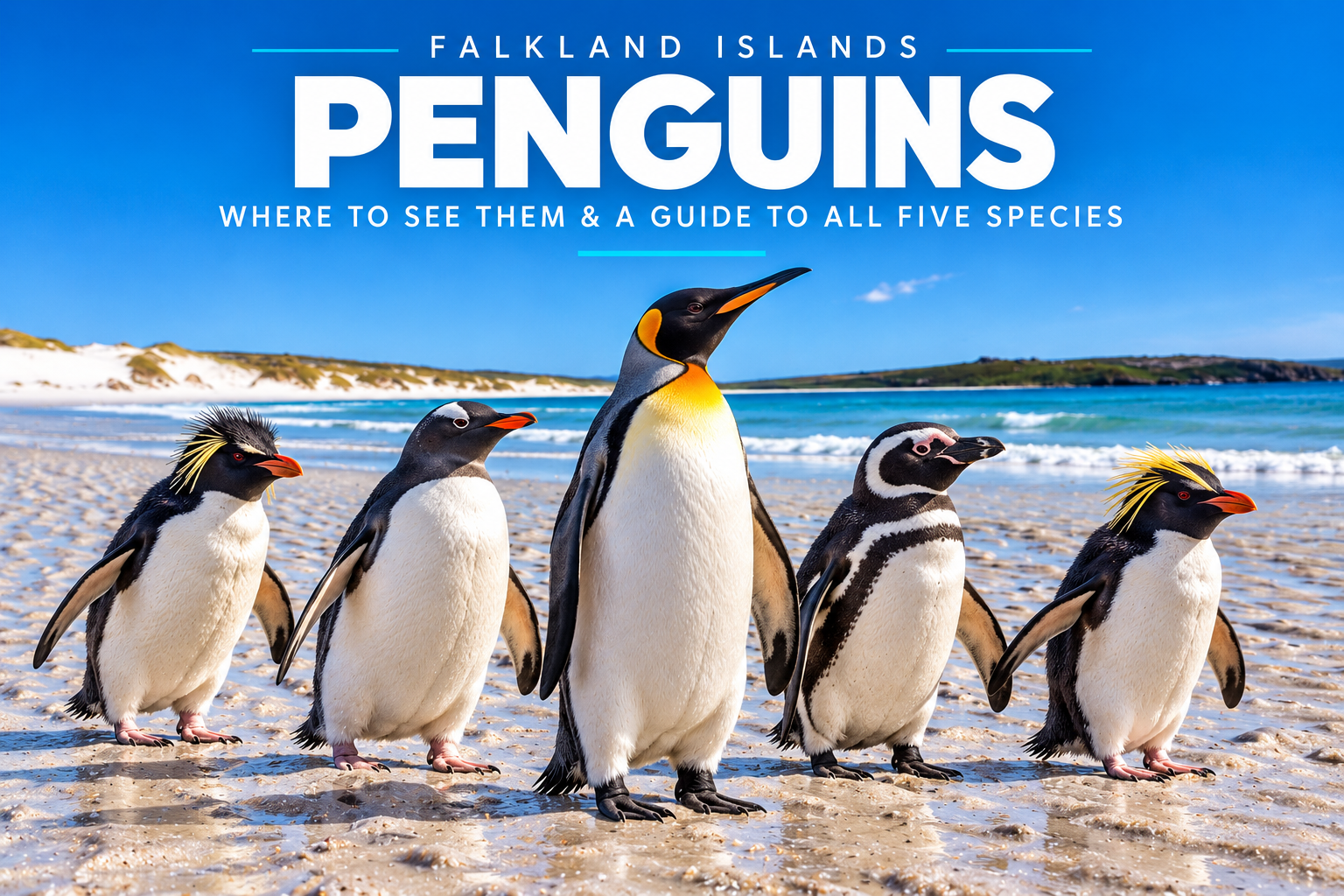
Where to See Penguins in the Falkland Islands: A Guide to All Five Species
Five species. Hundreds of islands. And a lot more than one famous penguin colony.
For many travellers, the first image that comes to mind when thinking about wildlife in the Falkland Islands is a penguin.
Usually a king penguin.
And there is a good reason for that.
Standing among the thousands of birds at Volunteer Point is one of the great wildlife experiences of the Falklands.
But it is only the beginning.
Five species of penguin breed in the islands:
King penguins. Gentoo penguins. Southern rockhopper penguins. Magellanic penguins. And, in much smaller numbers, macaroni penguins.
They don’t all live in the same places.
They don’t breed at the same time.
They don’t behave in the same way.
Some gather on broad beaches. Others disappear into burrows. Rockhoppers negotiate cliffs that look almost impossible for a flightless bird. King penguins follow a breeding cycle so long that different generations can be present in the colony at the same time.
The Falklands are also globally important for several of these species. Falklands Conservation describes the islands as supporting significant concentrations of gentoo and southern rockhopper penguins, while long-term monitoring takes place at colonies across the archipelago. falklandsconservation.com
So if seeing penguins is one of the reasons you’re travelling to the Falklands, our first piece of advice is simple:
Don’t think only about seeing a penguin.
Think about which species you want to see, what you want to watch them doing, and how much time you’re prepared to give them.
That’s when things get interesting.
Which penguins live in the Falkland Islands?
The five breeding species are:
King penguin
Tall, unmistakable and famous for its orange-yellow markings. The Falklands’ principal breeding colony is at Volunteer Point.
Gentoo penguin
Energetic, widespread and one of the species you’re most likely to encounter around the islands.
Southern rockhopper penguin
Small, charismatic and spectacularly adapted to rocky coastlines and steep cliffs.
Magellanic penguin
A burrow-nesting penguin commonly found around beaches and coastal grassland.
Macaroni penguin
The rarity of the group. Macaronis breed in very small numbers in the Falklands and should be considered a bonus sighting rather than an expectation.
The extraordinary part isn’t simply having five species.
It’s being able to experience them in completely different environments.
1. King penguins
If there is one Falklands penguin that needs almost no introduction, it’s the king.
They are the second-largest penguin species in the world, smaller only than emperor penguins.
But their size isn’t necessarily what strikes you first.
It’s their presence.
King penguins are extraordinarily elegant birds, with a silvery-grey back, dark head and vivid orange-yellow markings.
And unlike the emperor penguin, you don’t need to travel onto Antarctic ice to see one.
Where to see king penguins in the Falklands
Volunteer point
For most visitors, the answer is Volunteer Point.
Located on East Falkland, Volunteer Point contains the largest breeding group of king penguins in the islands. Gentoo and Magellanic penguins are present too, making it possible to encounter three penguin species at the same location. falklandislands.com
The setting is part of the experience.
A long white-sand beach faces the South Atlantic, with penguins moving between the water, beach and colony.
And then there is the noise.
People sometimes imagine penguin colonies as peaceful places.
They aren’t.
A large colony is an ongoing conversation.
Adults call.
Chicks call.
Neighbours disagree.
Birds come and go.
Stand there long enough and what initially sounds like chaos begins to make more sense.
King penguin chicks
King penguins are unusual because their breeding cycle takes longer than a year.
A pair therefore cannot simply produce one chick every summer in the way we might expect from a conventional annual breeding cycle. Falklands Conservation describes the cycle as more than one year, with a pair typically raising two chicks every three years. falklandsconservation.com
This creates one of the most fascinating sights at Volunteer Point.
Different birds can be at different stages of the breeding cycle simultaneously.
Large brown chicks may gather together in crèches while adults come and go around them.
Young birds eventually moult from their thick brown down into adult plumage before heading to sea.
The result is a colony that changes constantly rather than having one simple “chick season.”
When should you see king penguins?
King penguins can be present throughout the visitor season, but January through March can be particularly rewarding at Volunteer Point.
Current Falkland Islands tourism guidance highlights this period because chicks and adults can be observed through important stages of their breeding cycle. falklandislands.com
But kings are only one part of the Falklands penguin story.
2. Gentoo penguins
Gentoos are different.
If king penguins sometimes appear dignified, gentoos often seem to have somewhere urgent to be.
They’re wonderfully active birds.
They’re also one of the great Falklands penguin species because they occur at numerous locations around the archipelago.
In fact, the Falklands are globally important for gentoos. Research collated by the British Antarctic Survey estimated that the Falklands population accounted for roughly 30% of the global gentoo breeding population in its assessment. British Antarctic Survey
That makes them much more than a supporting act to the kings.
When do gentoo penguins breed?
The gentoo season follows a much more recognisable annual rhythm.
In September, birds begin returning and building nests.
Around mid-October, eggs are laid.
November is largely incubation.
Then things change quickly.
Early December: eggs begin hatching.
Early January: chicks start forming crèches.
February: both parents forage to feed rapidly growing chicks, with some young potentially fledging late in the month.
Early March: chicks generally fledge.
Adults then begin their annual moult later in March.
Interestingly, Falklands Conservation notes that up to half of the islands’ gentoos may remain around the Falklands during winter rather than dispersing completely. falklandsconservation.com
Why gentoo colonies are so enjoyable
Because they’re busy.
During summer, there is constant movement between the colony and sea.
Parents leave to forage.
Others return.
Chicks demand food.
Neighbours interact.
And young birds gradually become more adventurous.
If you visit during January, crèches can be particularly entertaining.
Groups of chicks gather while adults are away feeding, creating what can look remarkably like a slightly chaotic penguin nursery.
But watch individuals rather than the whole group.
That’s where the behaviour becomes interesting.
3. Southern rockhopper penguins
Then there are the rockhoppers.
They’re smaller.
They’re louder.
They’re equipped with extravagant yellow crests.
And they appear to have ignored the obvious evolutionary question:
Wouldn’t it be easier to live somewhere flatter?
Instead, rockhoppers choose rocky shorelines and dramatic cliffs.
Watching them return from the sea can be astonishing.
They launch themselves from water onto rocks, then hop and scramble upward toward their colonies.
Sometimes the route looks difficult enough for a human wearing hiking boots.
The penguins simply get on with it.
When do rockhopper penguins breed?
The southern rockhopper cycle in the Falklands is concentrated into the austral spring and summer.
Males typically arrive at breeding colonies in early October, followed by females roughly a week later.
Eggs are generally laid in early November.
They hatch in early December.
Parents brood-guard their chicks for around 25 days before the chicks begin forming crèches in January.
Young birds grow through February and typically fledge around early March.
Adults then feed at sea briefly before returning to moult. falklandsconservation.com
So if you want the full visual spectacle of rockhopper colonies with chicks, December through February is particularly interesting.
Why rockhoppers matter?
The Falklands support one of the world’s major southern rockhopper populations.
Historical numbers have fluctuated considerably, and the species has experienced serious long-term declines. Long-term conservation monitoring therefore remains important. Falklands Conservation currently notes that southern rockhoppers remain classed as Vulnerable and are one of the seabirds monitored through its Falkland Islands Seabird Monitoring Programme. falklandsconservation.com
This adds another dimension to seeing them.
You’re not simply visiting an entertaining penguin colony.
You’re seeing part of a globally significant population.
4. Magellanic penguins
Magellanic penguins don’t always get the attention they deserve.
Perhaps that’s because they’re less flamboyant than kings or rockhoppers.
But their lifestyle makes them fascinating.
Magellanic penguins nest in burrows.
Walk through suitable coastal habitat and you may hear one before you see it.
A head appears at the entrance of a burrow.
Another bird crosses the grass.
And then there is the call.
Magellanic penguins are sometimes called “jackass penguins” because their braying calls can sound remarkably donkey-like.
It’s not necessarily the soundtrack first-time visitors expect from a penguin colony.
When do Magellanic penguins breed?
Magellanic penguins return in spring and begin preparing their nests.
Eggs are generally laid around mid-October.
November is incubation.
Hatching occurs around the middle of December.
By February, growing chicks begin leaving their burrows.
Fledging generally takes place around mid-March, after which adults begin their annual moult.
The birds then disperse along the South American coast. falklandsconservation.com
For visitors, February can therefore be particularly rewarding because chicks that spent much of the early season hidden underground become considerably more visible.
Where can you see Magellanic penguins?
They are widespread.
Even travellers staying relatively close to Stanley can encounter them. The Falkland Islands Tourist Board identifies Gypsy Cove, about 8.5 kilometres from central Stanley, as an accessible location for seeing Magellanic penguins. falklandislands.com
But seeing them farther into the archipelago creates a different experience.
That’s one of the recurring themes of Falklands wildlife travel.
You don’t necessarily need to travel far to see wildlife.
You travel farther to experience more of the environment in which it lives.
5. Macaroni penguins
And finally, the difficult one.
Macaroni penguins.
They resemble rockhoppers at first glance, with dramatic yellow-orange crests, but they are a separate species.
They also breed in very small numbers in the Falklands compared with the other four penguins.
This means we approach them differently.
We don’t build an itinerary around guaranteeing one.
We don’t promise a photograph.
If we encounter one, wonderful.
If we don’t, we’ve still spent time among four other extraordinary penguin species.
That’s how wildlife travel should work.
The rarer the animal, the less comfortable we should be pretending nature owes us an appearance.
Can you see all five Falklands penguins on one trip?
Potentially.
But this shouldn’t become the sole measure of whether an expedition has been successful.
King, gentoo, rockhopper and Magellanic penguins can all form realistic parts of a well-designed Falklands wildlife journey during the appropriate season.
Macaroni penguins are much less predictable.
A better objective is to experience several species in different habitats.
See kings on a broad beach.
Watch Magellanics around their burrows.
Sit near an active gentoo colony.
Walk to a rockhopper colony on a wild headland.
Then, if a macaroni happens to appear, consider it a gift.
What are the best places to see penguins in the Falklands?
There isn’t a single answer.
And that’s exactly why the Falklands deserve more than a two-day visit.
Volunteer Point
Best known for the Falklands’ largest breeding concentration of king penguins.
Gentoo and Magellanic penguins are also present.
For travellers staying in Stanley, it’s one of the classic wildlife journeys.
Saunders Island
Saunders is one of our favourite Falklands locations because of its combination of species diversity, scenery and walking.
It’s the kind of place where wildlife becomes part of a broader landscape experience rather than an isolated attraction.
The outer islands
Travel farther into the archipelago and the possibilities multiply.
Remote islands can support gentoo, Magellanic and rockhopper colonies alongside albatrosses and other seabirds.
This is where exploring by small expedition vessel becomes particularly valuable.
Some locations simply cannot be reached by road or aircraft.
And reaching a colony by sea changes the experience before you’ve even stepped ashore.
October or January? Choosing when to see penguins
This is where many travellers make a mistake.
They ask:
“When are there penguins?”
A better question is:
“What do I want to see the penguins doing?”
Because a colony in October and exactly the same colony in January are not the same experience.
October
Think courtship, nesting and egg laying.
Gentoo and Magellanic penguins are laying eggs around mid-month.
Rockhoppers are returning to colonies.
This is for travellers interested in the beginning of the breeding story.
November
Incubation.
Gentoo and Magellanic penguins are sitting on eggs while rockhoppers lay and incubate theirs.
It can appear quieter than chick season, but behaviour around the colonies is fascinating.
December
Hatching.
Gentoo chicks begin appearing early in the month.
Rockhopper chicks hatch around the same period.
Magellanic chicks generally follow around mid-December.
This is when colonies change dramatically.
January
Chicks and crèches.
For many first-time wildlife travellers, January offers the classic Falklands penguin experience.
Days are long.
Colonies are active.
Young gentoos and rockhoppers gather in crèches.
And there is plenty of daylight for photography, walking and exploration.
February
The chicks are getting bigger.
Some are beginning to move towards independence.
Magellanic chicks increasingly emerge from their burrows.
Photographically, this can be wonderful because young birds are active and visible.
March
Fledging.
Young gentoo and rockhopper penguins generally fledge early in March, with Magellanics following around mid-month.
Adults then move into their annual moult.
For the complete wildlife calendar, read our Best Time to Visit the Falkland Islands: Month-by-Month Guide.
The best penguin encounter might involve doing nothing
People naturally want to know how close they’ll get.
We think that’s slightly the wrong question.
The better question is:
How can I watch without changing what the penguin is doing?
Current Falkland Islands Countryside Code guidance recommends keeping at least 6 metres / 20 feet from wildlife and never positioning yourself between an animal and its route to the sea. falklandislands.com
But six metres isn’t a target.
It’s not “get exactly six metres away.”
If a bird changes its behaviour because of you, give it more room.
And if a penguin approaches you?
Stay still.
Let the bird make the decision.
Some of the most memorable encounters happen precisely because you’ve stopped trying to create one.
Penguin photography in the Falklands
Photographers often arrive thinking about focal length.
400mm?
500mm?
600mm?
Those lenses can certainly be useful.
But one of the wonderful things about the Falklands is that eventually you may start reaching for something wider.
Because a penguin isn’t just a bird.
It’s a bird somewhere.
A gentoo crossing a huge empty beach tells you something about the Falklands.
Rockhoppers climbing a cliff tell you something about their lives.
A king colony seen within the surrounding landscape gives a sense of scale that another tightly framed portrait can’t.
And then there is time.
This might be the Falklands’ greatest photographic advantage.
At the right locations, with relatively few people around, you can sit and observe.
Watch first.
Photograph second.
You begin noticing where birds move.
How parents and chicks interact.
Where the light is falling.
What is happening behind the subject.
And suddenly you’re not collecting photographs of penguins.
You’re photographing penguin behaviour.
That’s a very different thing.
Penguins aren’t the whole wildlife story
It’s worth remembering this when planning an itinerary.
A journey designed entirely around penguins can accidentally overlook some of the Falklands’ greatest wildlife experiences.
At the same time as you’re watching penguins, black-browed albatrosses may be breeding on nearby cliffs.
Elephant seals may be on beaches.
Sea lions may be raising pups.
Commerson’s dolphins might appear beside the Zodiac.
And later in summer, whale opportunities increase.
The Falklands are particularly special because these experiences overlap.
Our Falkland Islands Wildlife Guide explores the wider story of albatrosses, seals, dolphins, whales and other seabirds alongside the penguins.
Why we prefer spending longer in the Falklands
A short cruise call can provide a wonderful introduction.
You might see a major penguin colony.
You might take some extraordinary photographs.
And you might leave thinking:
I’ve seen the Falklands.
Our answer?
You’ve scratched the surface.
A dedicated journey gives you the chance to see several species in different landscapes and at different stages of their lives.
You can walk.
Wait.
Return.
Change plans because of weather.
Travel to islands inaccessible by road.
And sometimes spend an afternoon doing something that would look completely unproductive on an itinerary:
sitting with penguins.
For us, that’s not wasted expedition time.
That’s the point of being there.
Which penguin would we choose?
We wouldn’t.
That’s the easy answer.
Kings have presence.
Gentoos have energy.
Rockhoppers have character.
Magellanics reward patience.
And macaronis bring the excitement of seeing something genuinely uncommon.
But some of our favourite experiences haven’t involved identifying species at all.
They’ve involved sitting quietly enough that the colony stops feeling like a spectacle.
You begin watching individual animals.
A pair interacting.
A chick demanding food.
A bird stealing nesting material from its neighbour.
Another returning from the sea.
And somewhere along the way you realise you haven’t taken a photograph for ten minutes.
That’s when you’re experiencing the Falklands properly.
Frequently Asked Questions
How many species of penguin are there in the Falkland Islands?
Five penguin species breed in the Falklands: king, gentoo, southern rockhopper, Magellanic and macaroni penguins. falklandislands.com
Where is the best place to see king penguins?
Volunteer Point on East Falkland contains the largest breeding group of king penguins in the islands. Gentoo and Magellanic penguins are also found there. falklandislands.com
What is the best month for penguins in the Falklands?
There isn’t one universally best month. October and November are excellent for courtship, nesting and incubation; December brings hatching; January is particularly good for chicks and crèches; February brings growing chicks; and many young gentoos, rockhoppers and Magellanics fledge during March. falklandsconservation.com
Can you see penguin chicks?
Yes. Timing depends on species. Gentoo and rockhopper chicks generally begin hatching in early December, while Magellanic chicks usually hatch around mid-December. King penguins follow a much longer breeding cycle. falklandsconservation.com
Can you see penguins near Stanley?
Yes. Magellanic penguins can be seen at Gypsy Cove, around 8.5 kilometres from central Stanley, while other penguin locations can be reached on excursions from the capital. falklandislands.com
How close can you get to penguins?
Falklands guidance recommends remaining at least 6 metres / 20 feet from wildlife and never blocking an animal’s route to the sea. Wildlife may sometimes choose to approach closer; visitors should remain still and allow the animal to control the encounter. falklandislands.com
Explore the Falklands beyond the penguins
Come for the penguins if that’s what first draws you here.
We understand.
But give yourself enough time to discover everything around them.
The albatrosses.
The dolphins.
The empty beaches.
The farms.
The cliffs.
The wind.
The walks.
And the extraordinary scale of an archipelago that looks tiny on a world map.
Because seeing a king penguin is memorable.
Understanding why the Falklands are much more than a penguin destination is better.
Continue your Falklands journey
Read → The Ultimate Guide to Visiting the Falkland Islands
Read → Best Time to Visit the Falkland Islands: Month by Month
Read → Falkland Islands Wildlife Guide: Penguins, Albatrosses, Seals, Dolphins & Whales
Explore → LatitudeX Adventures Falkland Islands Signature Voyage