
Best Time to Visit the Falkland Islands: A Month-by-Month Guide
Penguins, albatrosses, elephant seals, sea lions, whales and long summer days — here’s what changes from October to March in the Falkland Islands.
There isn’t really one “best” month to visit the Falkland Islands.
There is a best time for what you want to experience.
Come in October and the islands are alive with courtship, nesting, egg laying and elephant seal pups.
November is a month of incubation and intense activity around breeding colonies.
December brings hatching.
January brings fluffy chicks, crèches and some of the longest days of the season.
February sees chicks growing rapidly and some beginning the transition towards independence.
By March, much of the summer wildlife season is approaching its finale, with fledging penguins and increasing opportunities to encounter whales.
For us at LatitudeX, the period around midsummer is particularly rewarding. The days are long, conditions tend to become more settled, and there is time — something that matters enormously in the Falklands.
But every month has a different character.
This guide takes you from October through March, explaining the typical conditions, what’s happening with the wildlife, what each month is particularly good for, and what we at LatitudeX enjoy about that part of the season.
First: what is summer really like in the Falklands?
One of the biggest misconceptions we encounter is that the Falklands must be covered in snow and ice.
They aren’t.
The climate is oceanic and considerably more temperate than Antarctica. Summer officially falls in December, January and February, and the Falkland Islands Tourist Board describes these as the prime visitor months, although spring and early autumn offer very different wildlife experiences.
Wind is the more important consideration.
The Falklands are famously exposed, and conditions can change quickly. A blue-sky morning can become something quite different later in the day.
That’s why we recommend layers, a windproof and waterproof shell, a good hat — and sunblock.
And don’t underestimate the light.
Around midsummer, the Falklands enjoy exceptionally long days, creating wonderful opportunities for walking, exploring and photography.
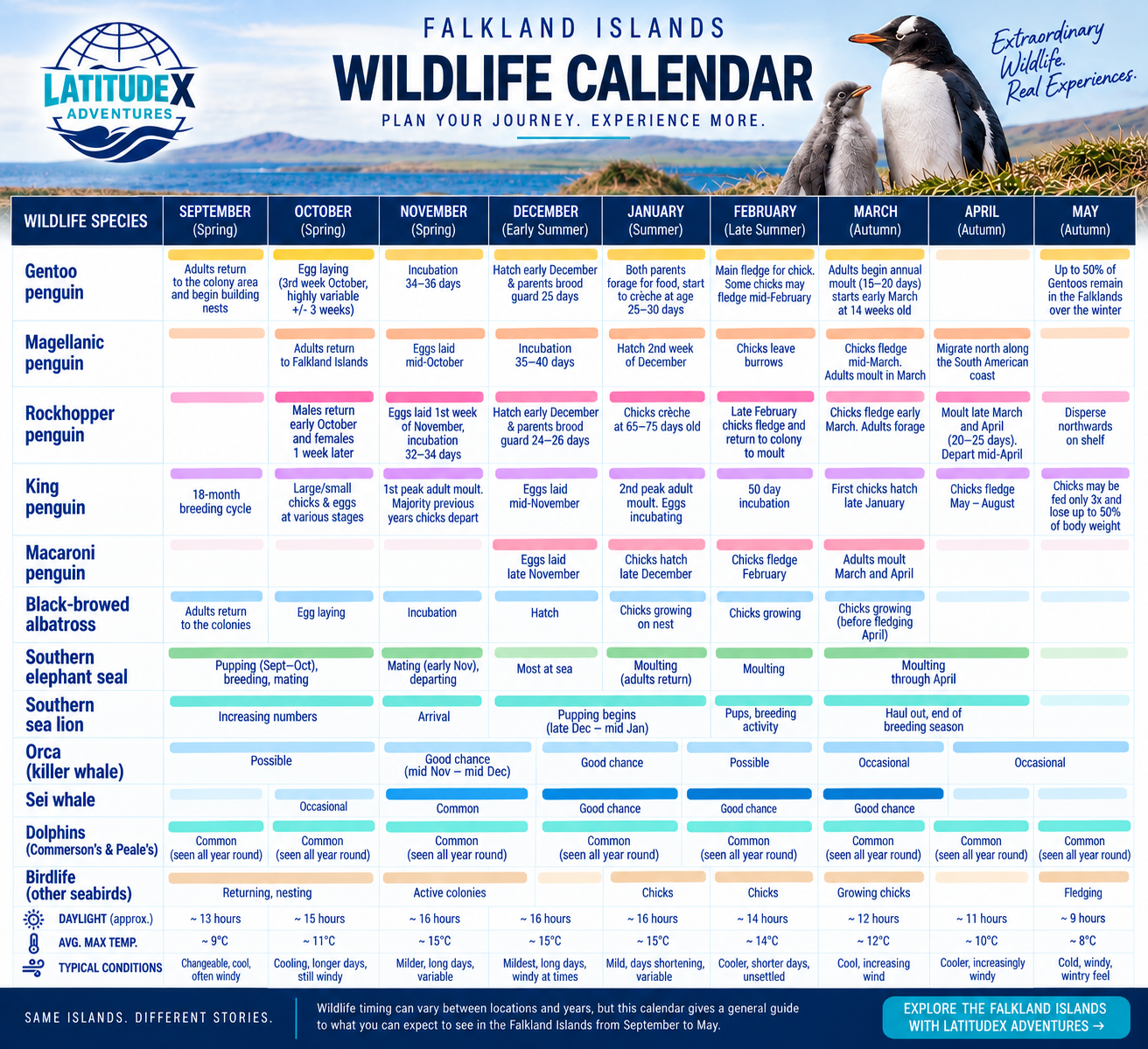
The Falklands wildlife season at a glance
| Month | Penguins & seabirds | Marine mammals | Particularly good for |
|---|---|---|---|
| October | Courtship, nesting and egg laying | Elephant seal pups; possible orcas | Breeding behaviour |
| November | Incubation across many colonies | Elephant seals mating; strong orca period at some locations | Active colonies |
| December | Penguin and albatross chicks begin hatching | Sea lions arrive and begin pupping | Newborn wildlife + very long days |
| January | Gentoo and rockhopper crèches; albatross chicks | Sea lion pups; elephant seals begin moulting | Wildlife + photography + walking |
| February | Growing chicks; some fledging begins | Sea lion pups; sei whale season strengthening | Photography + marine wildlife |
| March | Many penguin chicks fledge | Sea lions haul out; strong sei whale period | Whales + fledging + quieter exploration |
The exact timing varies according to species, location and year. Wildlife doesn’t read calendars — which is one of the reasons expedition travel remains interesting.
October: spring, courtship and new life
Typical conditions
October is spring in the Falklands.
Days are lengthening quickly and the islands are moving decisively out of winter, but conditions can still feel changeable and exposed.
This is not yet midsummer. Windproof and waterproof layers are important, particularly when spending long periods outside watching wildlife.
But what October lacks in summer warmth, it makes up for in energy.
The islands are waking up.
What’s happening with wildlife?
October is one of the most fascinating months for anyone interested in breeding behaviour rather than simply seeing animals.
Gentoo and Magellanic penguins typically lay their eggs around the middle of October.
Rockhopper penguins return to their breeding colonies during October, with males generally arriving first and females following.
Black-browed albatrosses have also returned to their colonies. Eggs are typically laid around October, beginning the long incubation period.
And then there are the elephant seals.
At important breeding sites such as Sea Lion Island, October is the height of the breeding season. Pups are born from late September into early October and suckle for only a few weeks before their mothers mate again and return to sea.
The scale can be extraordinary. Sea Lion Island supports the overwhelming majority of the Falklands’ elephant seal population, with thousands of animals present at the height of the season.
Orcas may also patrol around seal colonies during this period.
October is particularly good for…
Breeding behaviour.
If you’re fascinated by courtship, nesting, territorial behaviour, eggs and the beginning of the breeding cycle, October is compelling.
It is also a wonderful time for people who enjoy observing the process rather than simply arriving when every colony is full of fluffy chicks.
There is tension and purpose everywhere.
Birds are competing for nest sites. Partners reunite. Territories are defended. Elephant seal beaches can be extraordinarily active.
A LatitudeX observation
October reminds us that wildlife watching isn’t only about babies.
Watching a colony prepare for a breeding season can be every bit as interesting as seeing the chicks later.
Sit still for long enough and individual behaviours begin to emerge — nest building, courtship, territorial disputes and the endless movement between colony and sea.
That’s when you stop looking at a colony as “thousands of birds” and start noticing individual lives unfolding within it.
November: incubation and anticipation
Typical conditions
November brings longer days and moves the Falklands closer to summer.
Spring conditions can still be variable, and the wind remains part of everyday life, but there is increasingly generous daylight for exploring.
For photographers, those longer days begin to open up more opportunities to work with changing light rather than squeezing everything into a short window.
What’s happening with wildlife?
Across many penguin colonies, November is incubation month.
Gentoo and Magellanic penguins are generally sitting on eggs.
Rockhoppers typically lay their eggs around the beginning of November.
Black-browed albatrosses are also incubating. Their incubation period lasts around 69–72 days, with parents sharing responsibilities before the chicks appear around late December.
King penguins operate on a completely different timetable.
Their breeding cycle extends beyond a single year, so king penguin colonies can contain birds at different stages of the cycle simultaneously. During November, chicks from the previous year may be moulting before finally departing for the sea.
For elephant seals, November marks another dramatic stage.
After nursing their pups, females mate before returning to sea.
At Sea Lion Island there is another possibility: orcas.
The island is regarded as one of the Falklands’ best places to encounter them. They may be seen through summer, but the period from roughly mid-November to mid-December is particularly interesting because newly weaned elephant seal pups begin entering the water.
November is particularly good for…
Watching colonies at work.
There may be fewer chicks than later in summer, but breeding colonies are extraordinarily active.
It’s a month for birders, behavioural photographers and travellers interested in understanding the complete wildlife cycle.
And for anyone hoping to see orcas around Sea Lion Island, this can be a particularly interesting window — while remembering that wild animals never make appointments.
A LatitudeX observation
November is a good reminder of why we don’t like rushing wildlife encounters.
At first glance, an incubating colony might seem quieter than one filled with chicks.
Give it time.
Watch partners change responsibilities. Watch birds returning from the sea. Watch neighbours interact. Watch an albatross turn into the wind and leave the cliff almost without effort.
Often, the longer you sit, the more you see.
December: hatching season
Typical conditions
December marks the beginning of the Falklands’ summer.
The days around midsummer are exceptionally long, giving travellers an enormous amount of usable daylight.
The islands can also be sunnier and warmer than first-time visitors expect. The Falkland Islands Tourist Board notes that a typical summer day can combine wind with blue skies and sunshine.
That doesn’t mean predictable weather.
The wind remains part of the Falklands, and waterproof and windproof layers should always be accessible.
But December’s long days make it a particularly rewarding month for people who want to combine wildlife encounters with walking, photography and exploration.
What’s happening with wildlife?
December is hatching month.
Gentoo eggs generally begin hatching early in the month.
Rockhopper chicks also begin appearing around early December, after which their parents brood-guard them for several weeks.
Magellanic penguin eggs tend to hatch around the middle of December.
And towards the end of December, black-browed albatross chicks begin hatching.
At an albatross colony, that changes the character of the experience completely.
The elegant adults that have spent weeks incubating are suddenly caring for small down-covered chicks.
Marine mammals are changing too.
Most adult elephant seals have departed their breeding beaches, although pups may remain ashore for several weeks.
Meanwhile, southern sea lions are beginning their breeding season. Bulls establish territories and females start arriving around late December and early January, with pupping beginning around the same period.
December is particularly good for…
New life and maximum daylight.
This is one of the most exciting transitions in the wildlife calendar.
Eggs become chicks.
Sea lion breeding activity begins.
And there is enough daylight to combine serious wildlife observation with other experiences rather than feeling that every day is a race against sunset.
For photographers, the combination is particularly attractive: active colonies, young wildlife, dramatic landscapes and very long days.
A LatitudeX observation
This is when the Falklands begin to feel almost impossibly alive.
The temptation is to move quickly because there is so much happening.
We prefer the opposite.
Sit with the penguins.
Watch the albatrosses.
Give the place time.
Some of our favourite Falklands experiences have come from doing very little other than sitting quietly and watching penguins and albatrosses interact.
You don’t always need to go looking for the moment.
Sometimes you need to give the moment time to happen.
January: chicks, crèches and long summer days
Typical conditions
January sits at the heart of the Falklands summer.
It’s one of the best all-round months for combining wildlife, walking, photography and expedition travel.
Summer mean maximum temperatures are around 15°C / 59°F, according to Falkland Islands tourism information, but that number doesn’t tell the whole story.
In sunshine and out of the wind it can feel surprisingly mild.
On an exposed headland in a strong breeze, it can feel considerably cooler.
January also offers very long days. Around this part of summer, early sunrises give photographers and walkers a huge amount of usable daylight.
What’s happening with wildlife?
By January, some penguin colonies look very different from October.
Gentoo chicks begin forming crèches — groups of growing chicks gathering together while their parents forage at sea.
Rockhopper chicks also begin crèching.
King penguin colonies are different again. Because their breeding cycle extends beyond a conventional annual season, a colony can contain birds at several stages of breeding simultaneously.
Black-browed albatross parents continue caring for their chicks. The chicks remain on their nests, initially protected closely by adults before becoming increasingly independent.
Sea lion pups are now becoming a conspicuous part of the coastline at breeding locations, while females alternate between feeding their pups and heading to sea to forage.
Towards the end of January and into February, adult elephant seals begin returning ashore to moult.
January is particularly good for…
The complete Falklands experience.
Wildlife colonies are active.
There are chicks everywhere.
Days are long.
Walking conditions can be excellent.
Photography opportunities are abundant.
And locations such as Saunders Island allow wildlife and landscape to be experienced together — all five breeding penguin species can occur there, alongside black-browed albatrosses and superb walking.
A LatitudeX observation
January demonstrates something photographers quickly discover about the Falklands:
you don’t always need the biggest lens you’ve brought.
There can be extraordinary proximity to wildlife, and the surrounding landscape is part of the photograph.
Sometimes the more interesting image isn’t a tightly framed penguin portrait.
It’s a penguin on an enormous empty beach.
An albatross above a cliff.
A colony disappearing into the landscape.
And because the days are so long, you have something even more valuable than equipment:
time.
February: growing up
Typical conditions
February remains summer, but the season is beginning to turn.
Days are gradually shortening from their midsummer peak, although there is still plenty of daylight for exploration.
It can be a particularly rewarding period for travellers who want active wildlife colonies but also enjoy the feeling of late summer.
What’s happening with wildlife?
The young animals that appeared in December and January are now considerably more independent.
Gentoo parents continue making feeding trips for their chicks, and some young gentoos may begin fledging towards the end of February.
Young Magellanic penguins increasingly emerge from their burrows, giving visitors more opportunities to see chicks that were previously hidden underground.
Sea lion pups begin gathering together while still depending on their mothers for milk.
Black-browed albatross chicks continue growing rapidly on their nests. They won’t generally fledge until later in the autumn, but by February they are far removed from the tiny chicks of late December.
And another wildlife story is beginning offshore.
Sei whales become increasingly relevant from February onwards.
Falklands Conservation research found strong seasonal occurrence between February and May, with the most pronounced overall peak in March and April, although timing and abundance vary between years and locations.
Commerson’s and Peale’s dolphins can also be encountered in Falklands waters during summer.
February is particularly good for…
Photography, growing chicks and the beginning of stronger whale opportunities.
There is a different energy from December.
Instead of tiny chicks being guarded constantly by parents, you begin seeing young animals exploring, gathering and developing independence.
For photographers interested in behaviour, that’s wonderful.
A LatitudeX observation
One of the great advantages of the Falklands is the combination of wildlife abundance and lack of crowds.
That changes photography completely.
Instead of arriving, taking the photograph and moving on because somebody else is waiting, you can often spend time watching.
That allows you to anticipate behaviour.
And sometimes wildlife comes to investigate you.
We’ve experienced hundreds of Commerson’s dolphins appearing after becoming aware of our presence — playing around us, surfing through the waves close to the beach and moving around the Zodiacs.
Those encounters can’t be scheduled.
That’s exactly why they’re memorable.
March: fledging, whales and the changing season
Typical conditions
March marks the beginning of autumn.
The days are shortening and the main summer wildlife season is beginning to wind down, but March should not be dismissed as simply “the end of the season.”
Quite the opposite.
For some experiences, it’s one of the most interesting periods.
There may also be fewer visitors than during the heart of summer, adding to the sense of space that already defines the Falklands.
What’s happening with wildlife?
March is fledging time for many penguins.
Young birds that began life as eggs in spring are now preparing for independence and heading towards the sea.
King penguins continue following their unusual extended breeding cycle, with adults potentially sharing feeding responsibilities for young.
Southern sea lions begin hauling out.
Black-browed albatross chicks remain at their nest sites, continuing to grow before eventually leaving around April.
And offshore, March can be particularly interesting.
Long-term Falklands Conservation research into sei whales has found a strong seasonal peak around March and April in parts of Falklands waters, although abundance and timing vary significantly between years.
That means March offers something quite different from October.
The story has moved from arrival and reproduction to independence and departure.
March is particularly good for…
Fledging behaviour, whales, photography and travellers who enjoy the shoulder season.
It is particularly interesting for someone returning to the Falklands after experiencing the height of summer.
The same colony can feel completely different.
A LatitudeX observation
March illustrates why we think of the Falklands as somewhere to experience slowly.
Wildlife is constantly changing.
A colony isn’t one attraction that looks the same from October to March.
You can visit during courtship.
Return during hatching.
Come again when chicks are forming crèches.
And see something completely different as young birds finally head towards the sea.
That’s part of the fascination.
So, what is the best month to visit the Falkland Islands?
If we had to choose the best all-round period for a first visit, we would lean towards the period close to midsummer.
The weather tends to be more settled, days are exceptionally long, wildlife activity is intense and there is plenty of opportunity to combine wildlife watching with walking, photography and exploration.
But “best” depends on you.
Choose October if breeding behaviour and elephant seals particularly interest you.
Choose November for incubation, active colonies and the possibility of orca encounters around elephant seal sites.
Choose December for hatching, newborn chicks, the beginning of sea lion pupping and extraordinarily long days.
Choose January for chicks, crèches, wildlife photography and one of the strongest all-round combinations of wildlife and exploration.
Choose February for growing chicks, photography, late-summer exploration and increasing whale opportunities.
Choose March for fledging penguins, sei whale possibilities and a quieter end-of-season atmosphere.
There isn’t a month when nature guarantees a particular encounter.
And that’s important.
These are wild animals living according to weather, food availability and their own biological rhythms.
The calendar helps you choose.
It doesn’t write the itinerary.
Why flexibility matters in the Falklands
Weather affects every Falklands expedition.
Always.
That’s not something we try to hide when talking about the destination.
It’s one of the reasons we travel the way we do.
A small expedition vessel gives us the ability to adjust plans according to conditions and access places that cannot be reached by road or aircraft.
If conditions aren’t right for one location, we can consider another.
If wildlife presents an unexpected opportunity, we may be able to spend more time with it.
The objective isn’t to force the Falklands to conform to a rigid timetable.
It’s to understand the islands well enough to work with them.
A final thought about choosing when to come
If your dream is simply to photograph a king penguin, there are places and times when your chances are very good.
But we’d encourage you to think a little more broadly.
Do you want to see the breeding season beginning?
Chicks hatching?
Penguin crèches?
Albatrosses tending their young?
Elephant seal pups?
Sea lions?
Whales?
Long days for walking?
Or perhaps you want enough time that none of these things needs to be rushed.
For us, that last point matters most.
The Falklands reward time.
They reward sitting on a cliff and watching albatrosses.
Walking an empty beach.
Waiting for the light to change.
Watching penguins until you stop photographing them and simply start watching.
And occasionally sitting in a Zodiac while hundreds of Commerson’s dolphins decide that you are the interesting wildlife encounter.
That’s when the Falklands become much more than somewhere you’ve visited.
Continue planning your Falklands journey
The Ultimate Guide to Visiting the Falkland Islands →
Falkland Islands Wildlife Guide →